

Resisted and assisted sprint training: Determining the transfer to maximal sprinting
© Copyright 2017 YLMSportScience. All rights reserved.
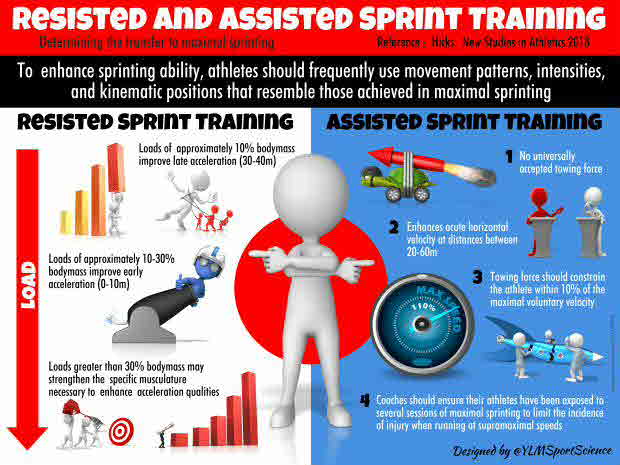
Resisted sprint training (RST) and assisted sprint training (AST) are methods used to overload the neuromuscular and physiological systems with the aim of causing adaptations that transfer to 'free' maximal sprinting (MS). This review of more than 50 publications summarises the effects of RST and AST with the aim of assisting coaches to understand their application. The author starts by identifying the principle of specificity as the primary consideration before examining the two methods in detail. RST has been shown to promote kinematic changes that emphasise propulsive force application in MS. RST using pulled sled loads of 10-30% body mass also appears to be effective in improving acceleration abilities while loads greater than 30% body mass appear to disrupt acceleration mechanics. AST using a horizontal towing mechanism over distances between 20-60m enhances acute maximal horizontal velocity. Across most reviewed studies, AST with towing or downhill running increases stride length while ground contact time decreases. Stride frequency, however, decreases or remains unchanged. This suggests that AST may not provide any greater transfer than a standard maximal sprinting protocol, but due to the inconsistencies in the research it should be left to the practitioner to determine whether AST is suitable.
© Copyright 2017 New Studies in Athletics. All rights reserved.
| Subjects: | |
|---|---|
| Notations: | strength and speed sports training science |
| Published in: | New Studies in Athletics |
| Language: | English |
| Published: |
2017
|
| Edition: | Volltexte der Beiträge mit 2 Jahren Karenz unter https://www.iaaf.org/nsa |
| Online Access: | http://trackandfieldplanner.com/product/resisted-assisted-sprint-training-new-studies-in-athletics/ |
| Volume: | 32 |
| Issue: | 1-2 |
| Pages: | 35-51 |
| Document types: | article |
| Level: | advanced |