

The acute:chronic workload ratio predicts injury: high chronic workload may decrease injury risk in elite rugby league players
© Copyright 2016 YLMSportScience. All rights reserved.
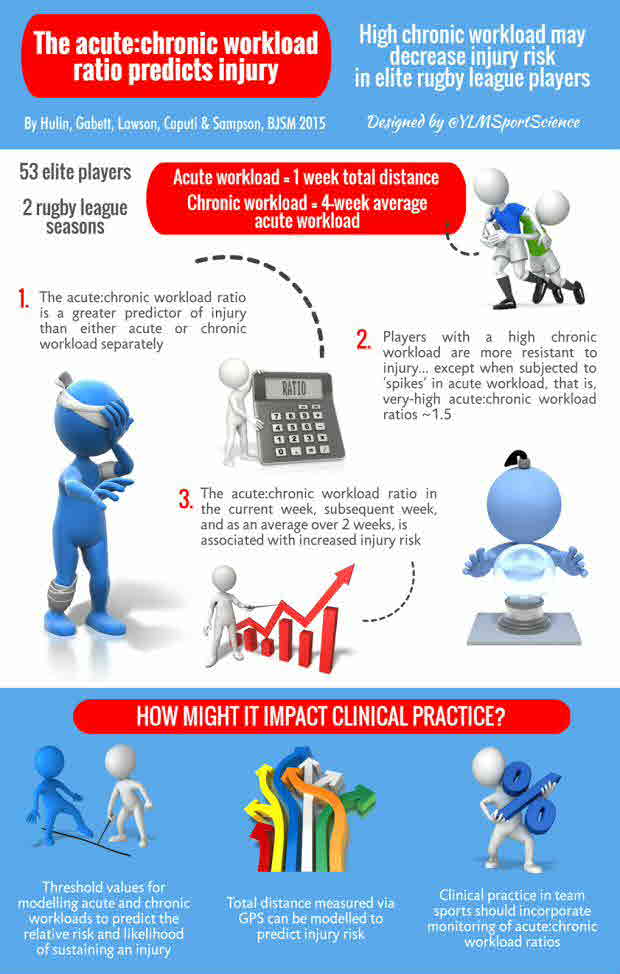
Aim: Investigate whether acute workload (1 week total distance) and chronic workload (4-week average acute workload) predict injury in elite rugby league players.
Methods: Data were collected from 53 elite players over two rugby league seasons. The `acute:chronic workload ratio` was calculated by dividing acute workload by chronic workload. A value of greater than 1 represented an acute workload greater than chronic workload. All workload data were classified into discrete ranges by z-scores.
Results: Compared with all other ratios, a very-high acute:chronic workload ratio (=2.11) demonstrated the greatest risk of injury in the current week (16.7% injury risk) and subsequent week (11.8% injury risk). High chronic workload (>16 095 m) combined with a very-high 2-week average acute:chronic workload ratio (=1.54) was associated with the greatest risk of injury (28.6% injury risk). High chronic workload combined with a moderate workload ratio (1.02-1.18) had a smaller risk of injury than low chronic workload combined with several workload ratios (relative risk range from 0.3 to 0.7×/÷1.4 to 4.4; likelihood range=88-94%, likely). Considering acute and chronic workloads in isolation (ie, not as ratios) did not consistently predict injury risk.
Conclusions: Higher workloads can have either positive or negative influences on injury risk in elite rugby league players. Specifically, compared with players who have a low chronic workload, players with a high chronic workload are more resistant to injury with moderate-low through moderate-high (0.85-1.35) acute:chronic workload ratios and less resistant to injury when subjected to `spikes` in acute workload, that is, very-high acute:chronic workload ratios -1.5.
© Copyright 2016 British Journal of Sports Medicine. BMJ Publishing Group Ltd of the BMA. All rights reserved.
| Subjects: | |
|---|---|
| Notations: | biological and medical sciences sport games |
| Published in: | British Journal of Sports Medicine |
| Language: | English |
| Published: |
2016
|
| Online Access: | http://bjsm.bmj.com/content/50/4/231.abstract |
| Volume: | 50 |
| Issue: | 4 |
| Pages: | 231-236 |
| Document types: | article |
| Level: | advanced |