

Concurrent training in Rugby Sevens: Effects of high-intensity interval exercises
© Copyright 2017 YLMSportScience. All rights reserved.
Purpose:
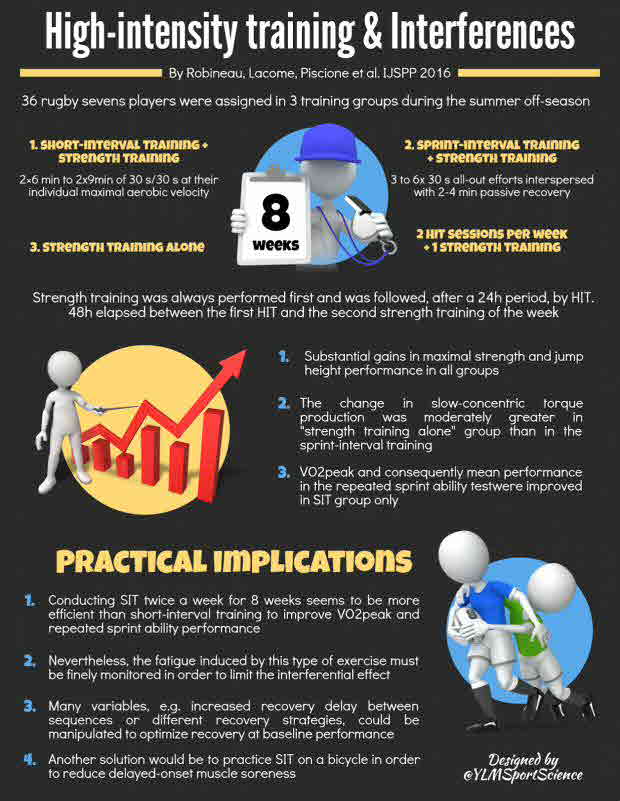
To assess the impact of 2 high-intensity interval-training (HIT) programs (short interval vs sprint interval training) on muscle strength and aerobic performances in a concurrent training program in amateur rugby sevens players.
Methods:
Thirty-six amateur rugby sevens players were randomly assigned to strength and short interval training (INT), strength and sprint interval training (SIT), or a strength-only training group (CON) during an 8-wk period. Maximal strength and power tests, aerobic measurements (peak oxygen uptake [VO2peak] and maximal aerobic velocity), and a specific repeated-sprint ability (RSA) test were conducted before and immediately after the overall training period.
Results:
From magnitude-based inference and effect size (ES ± 90% confidence limit) analyses, the current study revealed substantial gains in maximal strength and jump-height performance in all groups. The difference in change of slow concentric torque production was greater in CON than in SIT (0.65 ± 0.72, moderate). VO2peak and, consequently, mean performance in the RSA test were improved in the SIT group only (0.64 ± 0.29, moderate; -0.54 ± 0.35, moderate).
Conclusions:
The study did not emphasize interference on strength development after INT but showed a slight impairment of slow concentric torque production gains after SIT. Compared with INT, SIT would appear to be more effective to develop VO2peak and RSA but could induce lower muscle-strength gains, especially at low velocity.
© Copyright 2017 International Journal of Sports Physiology and Performance. All rights reserved.
| Subjects: | |
|---|---|
| Notations: | sport games |
| Published in: | International Journal of Sports Physiology and Performance |
| Language: | English |
| Published: |
2017
|
| Online Access: | https://doi.org/10.1123/ijspp.2015-0370 |
| Volume: | 12 |
| Issue: | 3 |
| Pages: | 336-344 |
| Document types: | article |
| Level: | advanced |