

Dietary protein for training adaptation and body composition manipulation in track and field athletes
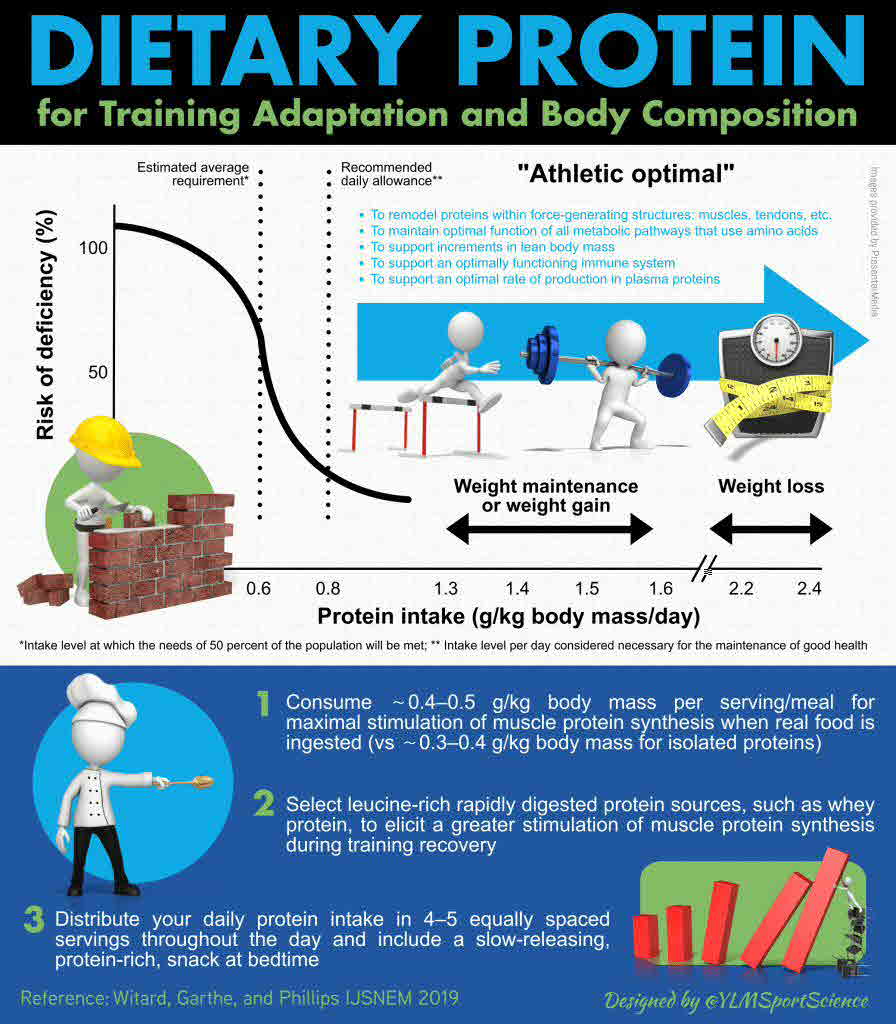
© Copyright 2019 YLMSportScience. All rights reserved.
Dietary protein is widely regarded as a key nutrient for allowing optimal training adaptation (Tipton, 2008) and optimizing body composition (Hector & Phillips, 2018; Murphy et al., 2015) in athletes including track and field athletes. Track and field athletics encompasses a broad spectrum of events including race walking; running (sprints, middle- and long-distance events, and hurdling); throwing (shot put, javelin, discus, and hammer); and jumping (long jump, triple jump, high jump, and pole vault), all with different ideals for the optimum performance physique (Hirsch et al., 2016). Most track and field athletes are familiar with the concept of high-quality weight loss (Sundgot-Borgen & Garthe, 2011), which describes the loss of fat mass while preserving, or even increasing, fat-free mass (i.e., muscle tissue) during a voluntary period of energy restriction. Many athletes engage in weight loss programs to "make weight" for competition (i.e., combat sports) or for aesthetic reasons (i.e., gymnasts and divers). However, the "Holy Grail" for most, if not all, track and field athletes during weight loss is to optimize their ratio of strength, power, or endurance to body weight for a performance advantage.
© Copyright 2019 International Journal of Sport Nutrition and Exercise Metabolism. Human Kinetics. All rights reserved.
| Subjects: | |
|---|---|
| Notations: | endurance sports strength and speed sports biological and medical sciences |
| Published in: | International Journal of Sport Nutrition and Exercise Metabolism |
| Language: | English |
| Published: |
2019
|
| Online Access: | https://doi.org/10.1123/ijsnem.2018-0267 |
| Volume: | 29 |
| Issue: | 2 |
| Pages: | 165-174 |
| Document types: | article |
| Level: | advanced |