

Low carbohydrate, high fat diet impairs exercise economy and negates the performance benefit from intensified training in elite race walkers
© Copyright 2016 YLMSportScience. All rights reserved.
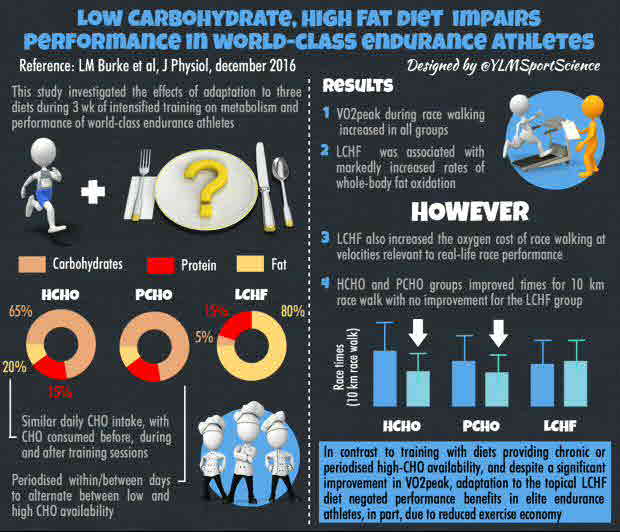
We investigated the effects of adaptation to a ketogenic low carbohydrate (CHO), high fat diet (LCHF) during 3 weeks of intensified training on metabolism and performance of world-class endurance athletes. We controlled three isoenergetic diets in elite race walkers: high CHO availability (g kg-1 day-1: 8.6 CHO, 2.1 protein, 1.2 fat) consumed before, during and after training (HCHO, n = 9); identical macronutrient intake, periodised within or between days to alternate between low and high CHO availability (PCHO, n = 10); LCHF (< 50 g day-1 CHO; 78% energy as fat; 2.1 g kg-1 day-1 protein; LCHF, n = 10). Post-intervention, VO2peak during race walking increased in all groups (P < 0.001, 90% CI: 2.55, 5.20%). LCHF was associated with markedly increased rates of whole-body fat oxidation, attaining peak rates of 1.57 ± 0.32 g min-1 during 2 h of walking at ~80% VO2peak. However, LCHF also increased the oxygen (O2) cost of race walking at velocities relevant to real-life race performance: O2 uptake (expressed as a percentage of new VO2peak) at a speed approximating 20 km race pace was reduced in HCHO and PCHO (90% CI: -7.047, -2.55 and -5.18, -0.86, respectively), but was maintained at pre-intervention levels in LCHF. HCHO and PCHO groups improved times for 10 km race walk: 6.6% (90% CI: 4.1, 9.1%) and 5.3% (3.4, 7.2%), with no improvement (-1.6% (-8.5, 5.3%)) for the LCHF group. In contrast to training with diets providing chronic or periodised high-CHO availability, and despite a significant improvement in VO2peak, adaptation to the topical LCHF diet negated performance benefits in elite endurance athletes, in part due to reduced exercise economy.
© Copyright 2016 The Journal of Physiology. Blackwell Publishing. All rights reserved.
| Subjects: | |
|---|---|
| Notations: | biological and medical sciences endurance sports |
| Published in: | The Journal of Physiology |
| Language: | English |
| Published: |
2016
|
| Online Access: | https://doi.org/10.1113/JP273230 |
| Volume: | 595 |
| Issue: | 9 |
| Pages: | 2785-2807 |
| Document types: | article |
| Level: | advanced |