

Presleep casein protein ingestion: Acceleration of functional recovery in professional soccer players
(Kasein-Protein-Einnahme vor dem Einschlafen: Beschleunigung der funktionellen Wiederherstellung bei Profifußballern)
© Copyright 2019 YLMSportScience. Alle Rechte vorbehalten.
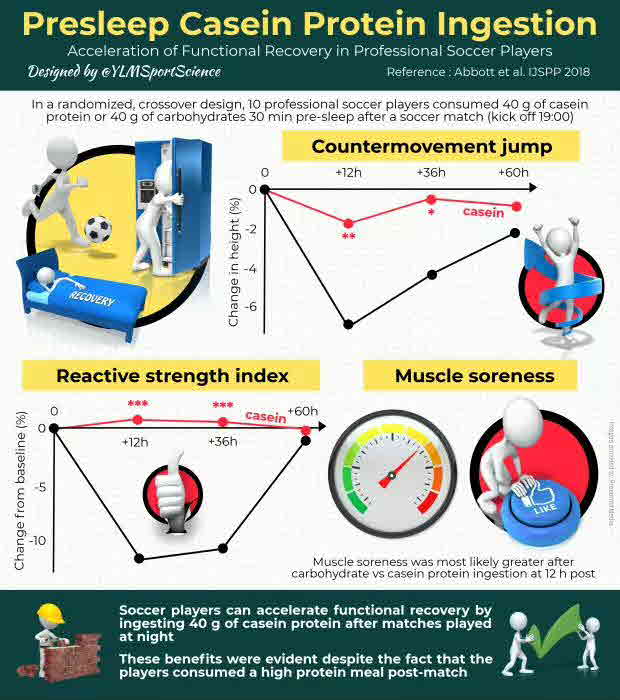
Purpose: To examine whether consuming casein protein (CP) before sleep would enhance recovery after a nighttime soccer match in professional players. Methods: In a randomized, crossover design, 10 professional soccer players from the reserve squad of a team in the highest tier of English soccer consumed 40 g of CP or 40 g of carbohydrates (CON) 30 min presleep after a soccer match (kick off: 7 PM). To assess recovery, countermovement-jump height, reactive strength index, muscle soreness, and the adapted Brief Assessment of Mood (BAM+) Questionnaire were measured before and 12, 36, and 60 h after each match. Dietary intake across the testing period was also recorded. Results: There were unclear differences in external load in the matches and dietary intake between CON and CP. Casein protein had a most likely and likely beneficial effect on countermovement-jump recovery at 12 and 36 h postmatch (CP -1.6; ±1.2% vs CON -6.6; ±1.7%; -4.1; ±2.3% vs -0.4; ±1.1%, respectively). Reactive strength index recovery was most likely enhanced with CP at 12 and 36 h postmatch, and muscle soreness, as measured with a visual analog scale (in millimeters), was most likely greater in CON versus CP at 12 h postmatch (72; ±17 vs 42; ±20 mm). BAM+ was possibly lower in CON at 36 h postmatch but unaffected at other time points. Conclusions: Presleep CP accelerates functional recovery in professional soccer players and, therefore, provides a practical means of attenuating performance deficits in the days after a match.
© Copyright 2019 International Journal of Sports Physiology and Performance. Alle Rechte vorbehalten.
| Schlagworte: | |
|---|---|
| Notationen: | Spielsportarten Biowissenschaften und Sportmedizin |
| Veröffentlicht in: | International Journal of Sports Physiology and Performance |
| Sprache: | Englisch |
| Veröffentlicht: |
2019
|
| Online-Zugang: | https://doi.org/10.1123/ijspp.2018-0385 |
| Jahrgang: | 14 |
| Heft: | 3 |
| Seiten: | 385-391 |
| Dokumentenarten: | Artikel |
| Level: | hoch |