

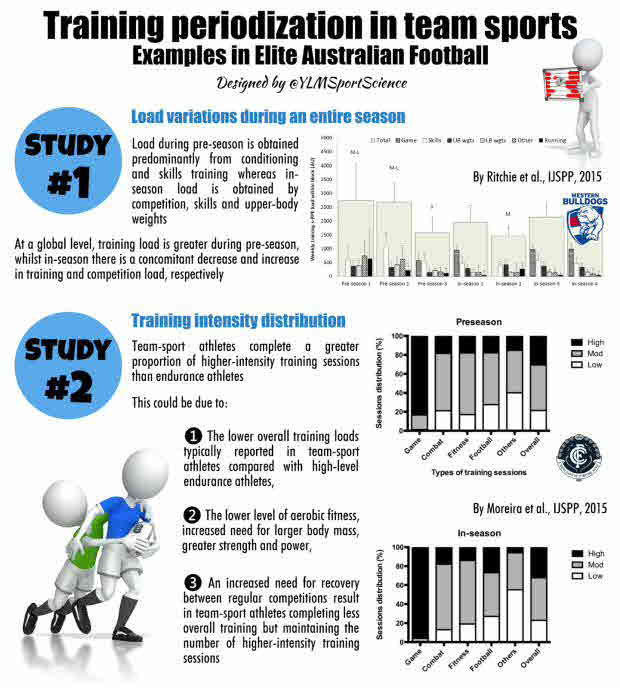
Quantification of training and competition load across a season in an elite australian football club
© Copyright 2016 YLMSportScience. All rights reserved.
Purpose:
Load monitoring in Australian football (AF) has been widely adopted, yet team-sport periodization strategies are relatively unknown. The authors aimed to quantify training and competition load across a season in an elite AF team, using rating of perceived exertion (RPE) and GPS tracking.
Methods:
Weekly totals for RPE and GPS loads (including accelerometer data; PlayerLoad) were obtained for 44 players across a full season for each training modality and for competition. General linear mixed models compared mean weekly load between 3 preseason and 4 in-season blocks. Effects were assessed with inferences about magnitudes standardized with between-players SD.
Results:
Total RPE load was most likely greater during preseason, where the majority of load was obtained via skills and conditioning. There was a large reduction in RPE load in the last preseason block. During in-season, half the total load came from games and the remaining half from training, predominantly skills and upper-body weights. Total distance, high-intensity running, and PlayerLoad showed large to very large reductions from preseason to in-season, whereas changes in mean speed were trivial across all blocks. All these effects were clear at the 99% level.
Conclusions:
These data provide useful information about targeted periods of loading and unloading across different stages of a season. The study also provides a framework for further investigation of training periodization in AF teams.
© Copyright 2016 International Journal of Sports Physiology and Performance. All rights reserved.
| Subjects: | |
|---|---|
| Notations: | sport games |
| Tagging: | Australian Football |
| Published in: | International Journal of Sports Physiology and Performance |
| Language: | English |
| Published: |
2016
|
| Online Access: | https://journals.humankinetics.com/doi/abs/10.1123/ijspp.2015-0294 |
| Volume: | 11 |
| Issue: | 4 |
| Pages: | 474-479 |
| Document types: | info graphics |
| Level: | advanced |