

Anthropometric injury risk factors in elite-standard youth soccer
© Copyright 2015 YLMSportScience. All rights reserved.
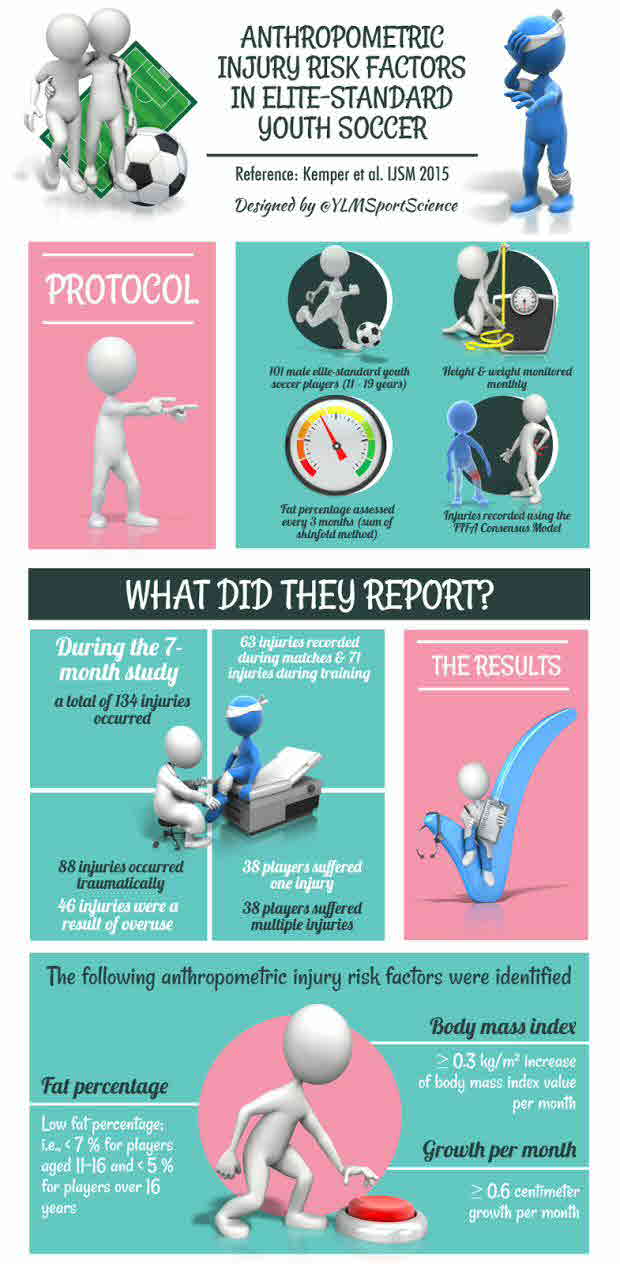
The aim of the study was to investigate whether an increased risk of injury occurrence can be determined through frequent anthropometric measurements in elite-standard youth soccer players. Over the course of one season, we followed 101 male elite-standard youth soccer players between 11 and 19 years of age. Height and body mass were monitored at monthly measurement intervals and fat percentage was assessed every 3 months by use of the sum of skinfold method. Growth in height (cm), alternations in body mass index (kg/m2), fat percentage and fat-free mass index (kg/m2) were calculated. Injuries were recorded in accordance with the recommendations of the FIFA Consensus Model for Injury Registration. Odds ratio scores and 95% confidence intervals were calculated using binary logistic regression analyses. The following anthropometric injury risk factors were identified: = 0.6 centimeter growth per month (p=0.03; OR=1.63; 95% CI: 1.06-2.52), = .3 g/m2 increase of body mass index value per month (p=0.03; OR=1.61; 95% CI: 1.04-2.49) and low fat percentage; i. e., < 7% for players aged 11-16 and < 5% for players over 16 years (p=0.01; OR=1.81; 95% CI: 1.18-2.76). Individual monitoring of anthropometrics provides useful information to determine increased risk of injury occurrence in elite-standard youth soccer.
© Copyright 2015 International Journal of Sports Medicine. Thieme. All rights reserved.
| Subjects: | |
|---|---|
| Notations: | biological and medical sciences junior sports sport games |
| Published in: | International Journal of Sports Medicine |
| Language: | English |
| Published: |
2015
|
| Online Access: | http://doi.org/10.1055/s-0035-1555778 |
| Volume: | 36 |
| Issue: | 13 |
| Pages: | 1112-1117 |
| Document types: | article |
| Level: | advanced |