

The relationship between the frequency of football practice during skeletal growth and the presence of a cam deformity in adult elite football players
© Copyright 2015 YLMSportScience. All rights reserved.
Background/aim: Cam deformity (CD) is likely a bony adaptation in response to high-impact sports practice during skeletal growth. We ascertained whether a dose-response relationship exists between the frequency of football practice during skeletal growth and the presence of a CD in adulthood, and if the age at which a football player starts playing football is associated with the presence of a CD in adulthood.
Methods: Prevalence of a CD (a angle>60°) and a pathological CD (a angle>78°) was studied using standardised anteroposterior (AP) and frog-leg lateral (FLL) radiographs that were obtained during seasonal screening. The age of starting to play football with a low frequency (LF; =3 times/week) and high frequency (HF; =4 times/week) was retrospectively assessed. The differences in prevalence of a CD per hip, in either view, between groups were calculated by logistic regression with generalised estimating equations.
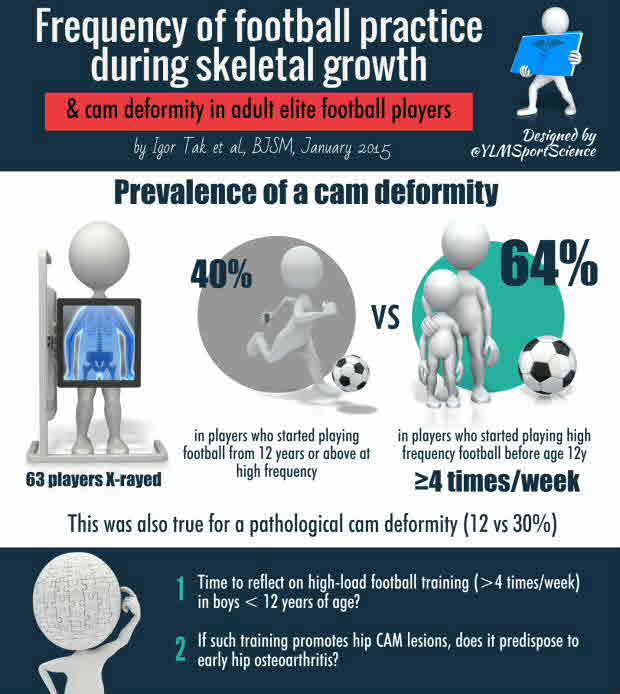
Results: 63 players (mean(±SD) age 23.1(±4.2) years) participated, yielding 126 hips for analysis. The prevalence of a CD in the FLL was 40% (n=82) in players who started playing HF football from the age of 12 years or above, and 64% (n=44) in those playing HF football before the age of 12 years (p=0.042). This was also true for a pathological CD (12% vs 30%, p=0.038). The AP views revealed no difference.
Conclusions: Our results indicate a probable dose-response relationship between the frequency of football practice during skeletal growth and the development of a CD, which should be confirmed in future prospective studies.
© Copyright 2015 British Journal of Sports Medicine. BMJ Publishing Group Ltd of the BMA. All rights reserved.
| Subjects: | |
|---|---|
| Notations: | biological and medical sciences sport games |
| Tagging: | Überlastung |
| Published in: | British Journal of Sports Medicine |
| Language: | English |
| Published: |
2015
|
| Online Access: | http://bjsm.bmj.com/content/49/9/630.abstract |
| Volume: | 49 |
| Issue: | 9 |
| Pages: | 630-634 |
| Document types: | article |
| Level: | advanced |