

A 11-day compressed overload and taper induces larger physiological improvements than a normal taper in elite cyclists
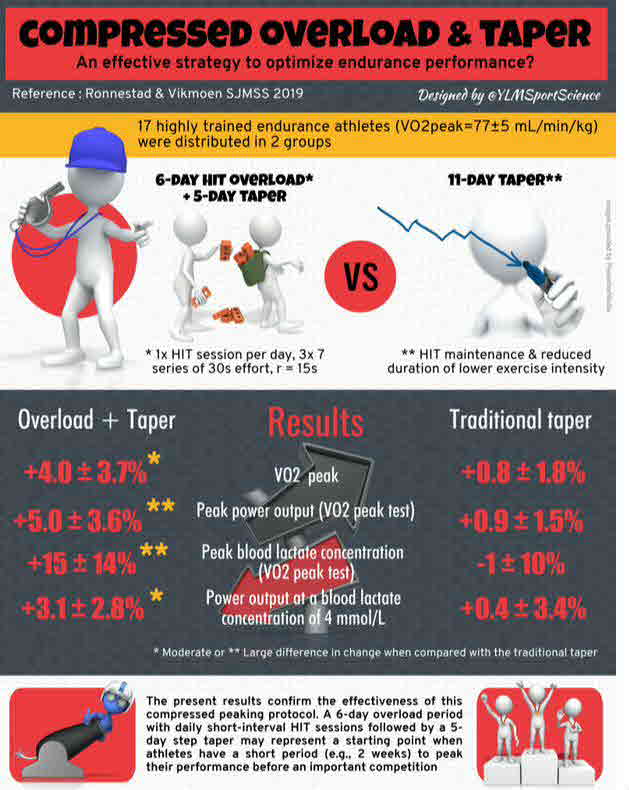
© Copyright 2019 YLMSportScience. All rights reserved.
Endurance athletes usually achieve performance peaking with 2-4 weeks of overload training followed by 1-3 weeks of tapering. With a tight competition schedule, this may not be appropriate. Thus, the aim of this study was to compare the effect of a compressed variant of the recommended overload and tapering approach (EXP; n=9, VO2peak=77±5 mL·min-1·kg-1) with a 11-day traditional taper that maintained the usual frequency of high-intensity aerobic interval training (HIT) and reduced the duration of training at lower exercise intensity (TRAD, n=8, VO2peak=74±4 mL·min-1·kg-1) on physiological and psychological variables of endurance performance. EXP performed a 6-day period with daily HIT followed by a 5-day step taper. Testing was performed before the intervention (pre), on the 7th (post-1), and on the 11th day of the intervention (post-2). From pre to post-2, EXP achieved a larger relative improvement than TRAD in VO2peak (4.0±3.7% vs. 0.8±1.8%, respectively, p=0.041) and the 1-min peak power output from the VO2peak test (5.0±3.6% vs. 0.9±1.5%, respectively, p=0.009) and had a tendency towards larger improvement in power output at a blood lactate concentration of 4 mmol·L-1 (p=0.088) and peak isokinetic knee-extension (p=0.06). The effect size of the relative improvement in the endurance variables revealed a moderate to large effect of EXP vs. TRAD. In conclusion, this study indicates that elite cyclists performing the present 11-day compressed performance peaking protocol consisting of a 6-day HIT overload followed by a 5-day step taper is superior to a 11-day taper only.
© Copyright 2019 Scandinavian Journal of Medicine & Science in Sports. Wiley. All rights reserved.
| Subjects: | |
|---|---|
| Notations: | endurance sports training science |
| Published in: | Scandinavian Journal of Medicine & Science in Sports |
| Language: | English |
| Published: |
2019
|
| Online Access: | https://doi.org/10.1111/sms.13536 |
| Volume: | 29 |
| Issue: | 12 |
| Pages: | 1856-1865 |
| Document types: | article |
| Level: | advanced |